
2026-10-09
By Dr. Kaustubh Waikar, MS (Gen. Surg), DNB (Neurosurgery), Neuro-Spinal Surgeon and Director, Siddhant Hospital & Research Center, Kolhapur
A fall from a two-wheeler, a road traffic accident, a slip in the bathroom, a blow during sports. Head injuries happen in an instant, and most people respond with a quick "I'm fine." Often that is true. But as a neurosurgeon, I have seen many patients who walked into the hospital talking normally and deteriorated within hours because of bleeding inside the skull that no one could see from the outside.
The difficulty is that the brain does not always show its injury right away. A small bump may need nothing more than rest, while a seemingly mild blow can cause a blood clot that slowly presses on the brain. Knowing which symptoms mean "go to the emergency room now" can protect your brain and, in some cases, save a life.
This guide explains why head injuries can be deceptive, the warning signs that need emergency care, what to do (and what not to do) while waiting for help, who is at higher risk, and how to recover safely.
The skull protects the brain, but a hard blow can make the brain move, twist, or strike the inside of the bone. This can bruise brain tissue, tear small blood vessels, or stretch nerve fibers. The skull is a closed, rigid space, so even a small amount of bleeding or swelling raises the pressure inside it. When pressure rises, the brain is squeezed and cannot work properly.
This build-up can be slow. A person may talk, walk, and seem completely normal after the accident, and then become drowsy, confused, or unresponsive hours later. Doctors sometimes call this a "lucid interval," and it is one of the main reasons a head injury should never be judged only by how someone looks in the first few minutes.
Severity also cannot be judged from the outside. A large scalp swelling or a bleeding cut may look frightening but be superficial, because the scalp has a rich blood supply. On the other hand, a serious brain injury can occur with no visible mark at all.
Not all head injuries are the same. The most common types are:
The more dangerous injuries, such as fractures and intracranial hematomas, need urgent medical and sometimes surgical treatment.
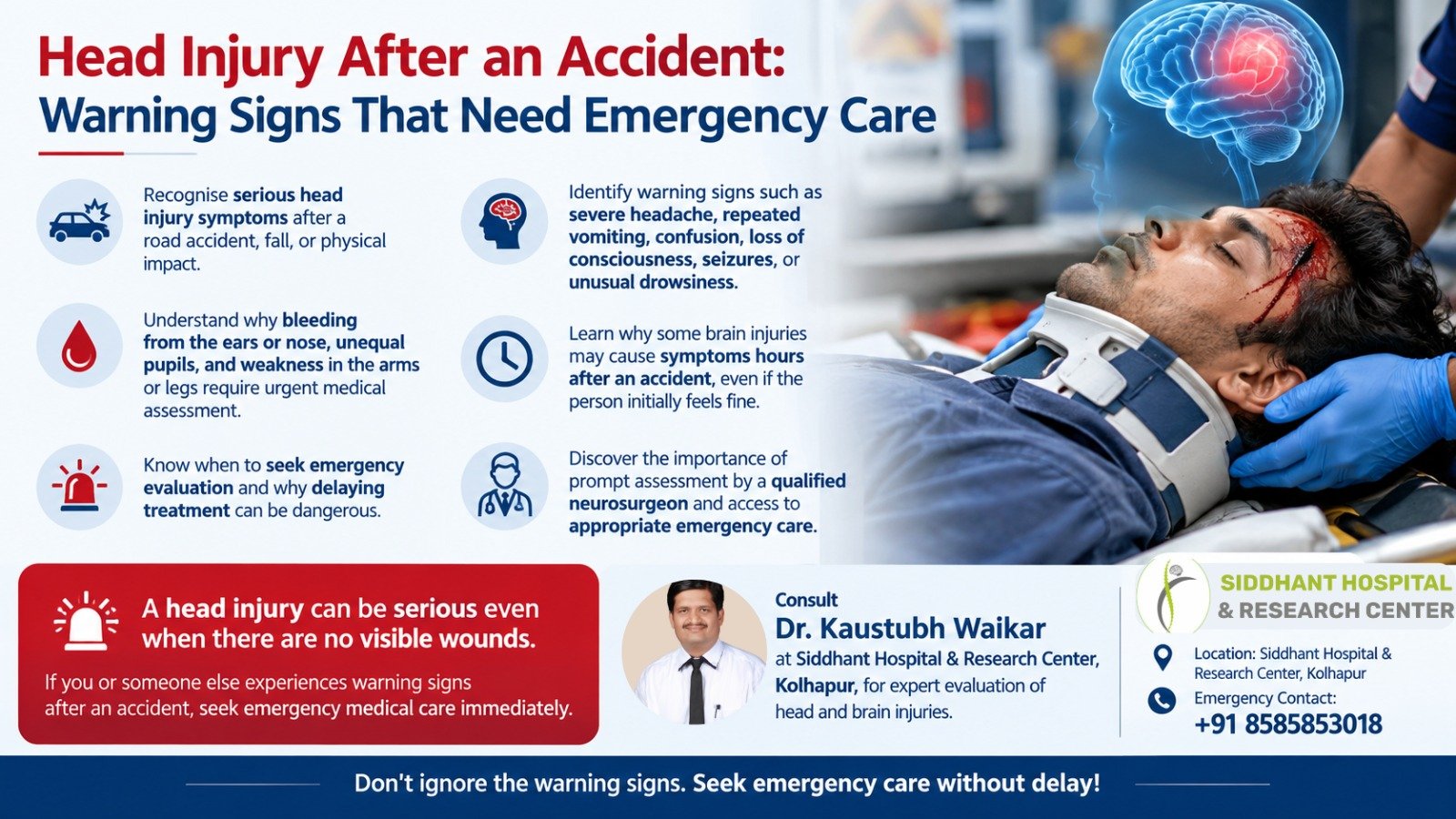
If a person has any one of the following after a head injury, call your local emergency number right away (112 in India) or take them to the nearest emergency department. Do not wait to see whether it gets better.
A strong blow to the head, especially in a road accident or a fall from height, can also injure the neck. If the person is unconscious, or complains of neck pain, tingling, or weakness, do not move them unless they are in immediate danger, such as from traffic or fire. Keep the head, neck, and back in a straight line. If the person is a motorcyclist, do not pull off the helmet unless trained to do so or the airway is blocked.
If the person vomits, and you must turn them, roll them onto their side as one unit, keeping the head, neck, and back aligned. This keeps the airway clear and reduces the risk of choking.
Some people are at higher risk of serious complications, and for them the threshold for seeking medical help should be lower. Even a seemingly minor blow deserves a medical check in these groups:
Serious symptoms do not always show up right away. For the first 24 to 48 hours after any head injury, someone responsible should stay with the injured person and check on them regularly. It is fine to let them sleep, but make sure they can be woken normally, recognize you, and speak sensibly. If they are hard to wake, seek emergency care at once.
Go to the emergency department if, at any point, you notice:
Delayed bleeding can occur in the first day or two, which is why observation matters. A chronic subdural hematoma, a slow collection of blood over the brain, can take weeks to cause symptoms, especially in older adults. Persistent headache, new confusion, drowsiness, or a tendency to fall in the weeks after a head injury should be reviewed by a doctor, even if the original injury seemed trivial.
Call for help first, then follow these steps until the ambulance arrives or you reach the hospital:
Do:
Do not:
On arrival, the emergency team first checks airway, breathing, and circulation, and stabilizes the neck if a spine injury is possible. They then assess how awake the person is, using the Glasgow Coma Scale, which scores eye opening, speech, and movement. They also check the pupils, limb strength, and reflexes, and look for other injuries, since head injuries often come with chest, abdomen, or limb trauma after a road accident.
Depending on the findings, the doctor may order a CT scan of the head, which is fast and very good at showing bleeding, fractures, and swelling. An MRI may be used later in selected cases, such as when symptoms do not match the CT findings. Blood tests may be done, especially for people on blood thinners.
The plan then depends on what is found:
The sooner treatment starts, the better the outcome, which is why timely arrival matters.
After a minor bump with no warning signs, a mild headache, slight dizziness, nausea, sensitivity to light or noise, or feeling a little foggy can occur and usually settle within days to a couple of weeks. Even then:
If symptoms are not improving after a week or two, or you develop trouble concentrating, poor sleep, mood changes, or headaches that persist, see a doctor. These can be signs of post-concussion symptoms, which respond well to proper guidance and a graded return to activity.
Many head injuries are preventable, and simple habits make a big difference:
When it comes to the head, it is always better to be cautious. Loss of consciousness, repeated vomiting, a worsening headache, confusion, seizures, weakness, or fluid from the nose or ears are never "wait and see" situations. If you are unsure whether symptoms are serious, get checked. A timely scan and a few hours of observation are a small price compared with the risk of missing a treatable bleed.
And if you are someone who rides a two-wheeler, drives long distances, or lives with an elderly parent, share this information with your family. Knowing the warning signs in advance is what allows you to act fast when it matters.
Siddhant Hospital & Research Center, Shenda Park, is a trusted Emergency Care Hospital in Kolhapur, providing 24/7 emergency services, dedicated Neuro ICU facilities, and trauma care for serious head and brain injuries. If you or someone you know experiences a head injury with any of the warning signs mentioned above, seek immediate medical attention at the nearest emergency department.
Emergency helpline: +91 8585853018
Address: Plot no. 15 B Ward, Ring Road, near Khatri Lawns, Shenda Park, Kolhapur, Maharashtra 416008
Warning signs include loss of consciousness, repeated vomiting, severe or worsening headaches, confusion, seizures, unusual drowsiness, blurred vision, or weakness in the arms or legs. Seek immediate medical attention if any of these symptoms occur.
Visit an Emergency Care Hospital in Kolhapur immediately if you experience loss of consciousness, repeated vomiting, worsening headaches, confusion, seizures, or difficulty staying awake after an accident. Do not wait for symptoms to become severe.
Yes. A head injury can cause internal bleeding, brain swelling, or a concussion even when there is no visible cut or external bleeding. Medical evaluation is important if symptoms develop after an accident.
Keep the injured person still and avoid unnecessary movement, especially if a neck or spinal injury is possible. Do not give food, drinks, or medication to an unconscious person. Call emergency services if the person is unconscious, having seizures, or showing serious symptoms.
Yes. Some symptoms, including headaches, confusion, vomiting, or drowsiness, may develop hours after an injury. Seek urgent medical evaluation if new symptoms appear or existing symptoms worsen.
Siddhant Hospital & Research Center, Shenda Park, Kolhapur, provides 24/7 emergency services, Neuro ICU facilities, and trauma care for serious head and brain injuries. Consult a medical professional promptly after a significant head injury.
For serious head injuries, seek emergency medical attention immediately. Dr. Kaustubh Waikar, Neurosurgeon and Spine Surgeon at Siddhant Hospital & Research Center, Kolhapur, provides specialist care for neurological conditions. Emergency assessment should not be delayed while arranging a specialist consultation.